

The hidden cost of a fixed TV mount isn't the hardware-it's the way it forces you to live around it.
For years, the TV mount conversation has been dominated by specifications: load capacity, VESA patterns, tilt degrees. But a quiet shift is happening in homes across North America, driven by a generation of viewers who refuse to arrange furniture around a screen.
The full-motion TV mount-once considered a utilitarian accessory for commercial spaces-has become the unexpected centerpiece of a new spatial philosophy. It's less about watching television and more about reclaiming the rooms we watch in.

The Geometry of a Glance
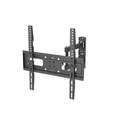
Consider the average living room. The sofa faces the fireplace. The fireplace doesn't face back. For decades, the solution was simple compromise: angle the TV toward the couch, accept the glare, or rearrange everything. Full-motion mounts dissolve that trade-off. With swivel ranges extending to 180 degrees and arm extensions reaching up to 1 meter, the screen adjusts to the room's architecture-not the other way around.
What's changed isn't just the hardware. It's the recognition that a home isn't a theater. It's a kitchen island where someone follows a recipe. It's a home office where a midday break happens at a desk. It's a bedroom corner where the only comfortable viewing angle is diagonal. Full-motion design acknowledges what fixed mounts ignore: people move.
The Technical Quietly Enabling the Shift
Today's articulating mounts are not your father's swing arms. The engineering has evolved toward near-invisibility. Premium models now sit just 2.15 inches from the wall when retracted-close enough to pass as a flush installation-while extending outward with movement that manufacturers describe as "effortless" and "steady," terms that translate to one-handed adjustments without drift or sag.
Integrated cable management, once an afterthought, now routes power and HDMI lines through the arm itself, eliminating the visual clutter that betrayed older articulating designs. Tool-free tilt adjustments and post-leveling mechanisms have made installation less about precision drilling and more about final calibration by hand.
Perhaps most telling: the market has responded. Analysts note that professional installation channels are growing faster than DIY, a signal that consumers are investing in mounts as permanent infrastructure rather than temporary fixes. The full-motion category, once a niche within a niche, now anchors the premium tier of a global market projected to expand steadily through 2032.
What the Couch Actually Sees
The numbers tell one story. The lived experience tells another.
A 65-inch television on a fixed mount offers exactly one optimal viewing position. Every other seat in the room receives a compromised image-glare, angle, distance. A full-motion mount multiplies that single position into a range. The corner chair becomes viable. The dining table sightline opens. The kitchen prep zone stays connected to the screen without turning the living room into a viewing corridor.
This is not a feature. It's a reconfiguration of how space functions around media. And it's happening in the most ordinary rooms, for the most ordinary reasons: someone wants to cook while watching the game. Someone wants to fold laundry without staring at a wall. Someone wants the TV out of the way when guests arrive and back in position when they leave.
The Takeaway
The full-motion TV mount succeeds precisely because it doesn't ask for attention. It disappears against the wall when idle. It extends when needed. It rotates, tilts, and returns. The technology is mature. The aesthetics are clean. What remains is the simplest question a homeowner can ask: why should the television dictate where I sit?
The answer, increasingly, is that it shouldn't.

