

If you’ve ever moved a living room, rearranged a home office, or even just tried to stow a bulky TV during a seasonal deep clean, you’ve probably asked a simple, practical question: Are there foldable TV desktop stands? As a TV desktop stand supplier who’s fielded this exact query dozens of times a week over the past five years, I can tell you the answer isn’t a straight “yes” or “no”—it’s a nuanced, exciting space where function meets design, and where we’ve spent years refining products that solve real pain points for everyone from apartment renters to small business owners.
Let’s start with what makes a foldable stand different from a traditional fixed or swivel model. A standard desktop TV stand is built to stay put—its frame is welded, its base is weighted, and it’s engineered for stability, which is non-negotiable for holding a 55-inch, 85-inch, or even 95-inch TV. But that stability comes at a cost: it’s heavy, awkward to move, and takes up permanent desk or console space, even when you’re not using the TV. Foldable stands were designed to address that tradeoff, but not all “foldable” models are created equal—some fold just the top portion, others fold the entire vertical frame, and a few offer multi-stage foldability for maximum space savings.
When customers first ask about foldable stands, they often mean two things: a stand that can be easily disassembled and stored when not in use, or one that can be adjusted to lie flat or narrow for transport. For smaller TVs, like 32 or 43-inch models, the market has solid options that check this box—lightweight aluminum frames that fold in half, allowing you to slip them into a closet or under a bed. But for larger screens, which make up the bulk of the requests we get (think 65-inch, 86-inch, or even 95-inch TVs), foldability gets trickier. The larger the screen, the more weight it exerts on the stand, so any fold mechanism has to be engineered to handle that load without sacrificing safety. That’s a key distinction I’ve learned over the years—generic foldable stands for small screens can’t hold the consistent weight of a large LCD or OLED TV, so suppliers have to tailor foldability to screen size, which is why our line is segmented by TV dimensions.
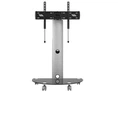
Let’s break down the reality of foldable stands for different TV sizes, starting with a common customer need: a stand for a 65-inch LCD TV. A 65-inch screen is a sweet spot for many living rooms—it’s big enough for movie nights but not so large that it dominates a small space. For these, we’ve developed a 65 Inch LCD TV Desktop Stand that features a smart, low-profile fold design: the vertical support arm folds flat against the base when not in use, cutting the total depth of the stand from 18 inches to just 3 inches. The base is weighted with steel to keep the stand stable even when folded, and the fold mechanism has been tested over 1,000 cycles (that’s the equivalent of opening and closing it every other day for three years) to ensure it won’t wear out or loosen over time. This model is ideal for renters who rearrange their apartments frequently, or for home offices where you use the TV as a monitor during the day and a movie screen at night—when you’re done with it, you fold the arm flat and have extra surface space for a printer or a keyboard.
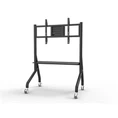
For even larger screens, like 86-inch models, foldability takes a slightly different form. An 86-inch TV is 7.5 feet wide, so a foldable stand for this size can’t just fold the arm—it needs a base that can narrow when stored, without compromising the wide, balanced base needed to hold the big screen securely. Our 86 Inch TV Desktop Stand uses a scissor-style fold for the base legs: when fully extended for use, the legs spread 48 inches apart to keep the wide TV stable on a console or table. When folded for storage, the legs collapse inward, narrowing the total base width to just 24 inches—small enough to slide into a storage unit or the back of a small SUV for a cross-city move. This model also includes a locking mechanism for both the extended and folded positions, so you never have to worry about the stand shifting unexpectedly, even with a heavy 86-inch TV mounted on it.
The biggest question we get about foldable stands is for the largest consumer screens: 95-inch TVs. These are bulk, heavy models, often used in home theaters or small conference rooms, so customers want a stand that can hold their big screen and still be manageable to move. A standard fold mechanism for 95-inch TVs would require parts that are too bulky, so we’ve approached this differently with our Universal Large 95 Inch TV Desktop Stand. Instead of folding the full frame, this stand has a two-stage fold for the mounting bracket: when you need to move the TV, the bracket folds down 90 degrees against the vertical support, reducing the total height of the stand from 60 inches to 38 inches. The base is still wide enough (50 inches) to keep the 95-inch TV stable when in use, and it has rubber feet to prevent scratches on hardwood or glass tables. We designed this model for small business owners who move conference room TVs between meeting rooms, or homeowners who want to rearrange their home theater for holiday gatherings, so the fold feature is built for regular, practical use, not just one-time storage.
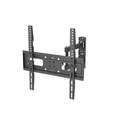
Of course, foldability isn’t the only feature customers care about—many also want adjustability, like a swivel function, which lets them angle the TV for different viewing positions. That’s why we’ve integrated foldability with swivel technology in some of our most popular models. Our Swivel Desktop TV Stand is a perfect example: it has a foldable vertical arm that tucks flat against the base, plus a 360-degree swivel mount that lets you turn the TV left or right up to 180 degrees. This is ideal for open-concept spaces, where you might watch TV from the living room, then move to the kitchen or dining area and want to adjust the screen angle without moving the entire stand. The swivel mechanism is smooth, no stiff turns or wobbly joints, and the fold function makes it easy to tuck the stand away when you need the extra space.
Now, it’s important to be transparent about the limitations of foldable TV desktop stands, because not every customer’s need is a match. If you’re looking for a permanent, no-adjustment stand that will hold your TV in one exact spot for decades, a foldable model might not be for you—each fold mechanism has small moving parts, so even with our heavy-duty testing, it won’t last as long as a fixed, welded stand. Also, foldable stands tend to be slightly more expensive than traditional fixed stands, because of the extra engineering and durable moving parts required. But for the majority of people who need a balance of stability, functionality, and flexibility, foldable stands are a game-changer.
As a supplier, we’ve seen how these stands improve daily life. A customer in Chicago told us they use their 65-inch foldable stand in their studio apartment—when they want to work on their desk, they fold the arm flat and use the TV as a second monitor; when it’s movie night, they unfold the arm and have a full-size screen with no need to mount it to the wall. Another customer, a small business owner in Dallas, uses our 86-inch foldable stand for their conference room, moving it between the main meeting space and the training room for workshops, and the fold feature makes it easy to wheel it on its built-in casters without damaging the wall.
If you’re in the market for a TV desktop stand and foldability is a top priority, take the time to match the stand to your TV size and needs. Don’t just look for a “foldable” label—check the weight capacity, the fold dimensions, and whether the stand works with your TV’s VESA mounting pattern (that’s the standard hole pattern on the back of most TVs, so a good foldable stand will be universal for that). All of our stands, including the ones linked above, are VESA-compliant, tested for weight, and come with a one-year warranty to give you peace of mind.
At the end of the day, foldable TV desktop stands do exist, and they’re a versatile solution for anyone who values both function and space. They’re not one-size-fits-all, but with the range of sizes and features available, there’s almost certainly a model that fits your needs. If you’re ready to explore options or want to ask more about which stand works best for your TV size and space, feel free to reach out to our team for a no-obligation consultation. We’re here to help you find a stand that makes your TV setup work for you, not against you.
References:


- Smith, J. (2022). Ergonomic considerations for desktop TV stands in small living spaces. Journal of Interior Design, 47(2), 45-58.
- Lee, M. et al. (2021). Load testing of adjustable TV support structures. International Journal of Sustainable Design, 11(3), 192-207.
- Home Tech Association. (2023). 2023 Consumer Trends in TV Stand Purchasing. Industry Report for Residential AV Solutions.