

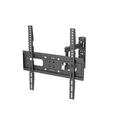
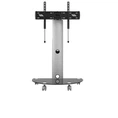
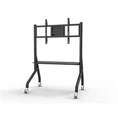
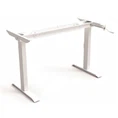
Standard wall-mounted displays are fixed in place once installed, making them ill-suited for scenarios requiring temporary presentations, cross-room sharing, or mobile displays across multiple locations. To address this, Handy offers a range of commercial display mounts and mobile carts. Designed to accommodate diverse environments, the product lineup includes standard, heavy-duty, motorized height-adjustable, tilt-and-swivel, and foldable/portable models. Compatible with screens ranging from 32 to 75 inches (and larger), these solutions balance structural stability with mobility, providing a robust hardware foundation for large-screen applications across various industries.
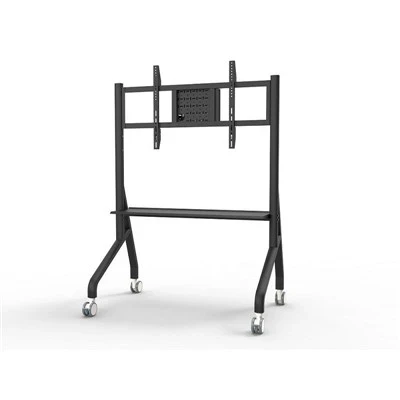
Here are some of the primary use cases:
1. Corporate Meeting Rooms / Open-Plan Offices: In companies where meeting rooms are scattered and large-screen usage schedules vary, equipping every space with a dedicated display can be cost-prohibitive. With a mobile cart, a single display can be moved between meeting rooms, discussion areas, and open workspaces-supporting video conferencing, project presentations, and internal training. The height-adjustable design allows for comfortable viewing while seated or, when raised, facilitates presentations while standing.
2. Educational Shared Spaces: In schools, large screens are often shared across multi-functional classrooms, lecture halls, and activity rooms. Carts equipped with locking casters allow for easy transport and secure, stable positioning-ideal for displaying course materials, hosting open lectures, conducting online classes, or showcasing student projects. If a school's layout changes, the equipment can simply be relocated without the need for additional renovation or construction.
3. Exhibitions and Temporary Events: The key requirements for such events are rapid setup and efficient teardown. Foldable, portable models are easy to assemble and disassemble; they are compact when stowed, making them simple to transport and allowing for the quick deployment of promotional screens.
4. Other Applications: These solutions are also well-suited for health education in hospital waiting areas and wards, temporary presentations for government services, large-screen displays for hotel banquet halls, and pre-shift training or safety information boards in factory workshops.
Key considerations for daily setup and use:
1. Before assembly, verify the screen's weight, dimensions, and the VESA mounting pattern on its rear. Strictly adhere to the cart's rated load capacity; never exceed it.
2. Assemble the base, upright column, and casters in sequence, ensuring all fasteners are securely tightened. Given the significant weight of the display and the fragility of the panel, attempting a one-person installation carries a high risk of accidental impact or damage to the screen.
3. Once positioned, engage the caster brakes to prevent unintended movement. Avoid placing the cart on slopes or uneven surfaces to minimize the risk of tipping.
4. Route power cords, network cables, and video cables through the integrated cable management channels to keep pathways clear and prevent tripping hazards. Distribute peripherals-such as cameras or set-top boxes-evenly; avoid clustering them on one side, which could shift the center of gravity.
5. Periodically check that all screws are tight and clear any debris tangled in the casters. For motorized height-adjustable models, regularly test the operation; if you notice any unusual noises or sticking, stop use immediately and perform an inspection.
A mobile cart is not a universal replacement for a wall mount, but rather a specialized structural solution designed for scenarios requiring dynamic deployment. Handy's diverse range of carts is engineered to address specific operational needs-such as stability, adjustability, and transport/storage-providing clients with comprehensive, integrated solutions for various environments.